Q&A with a Bwiti Fang Beti Ngoma (traditional harp player)
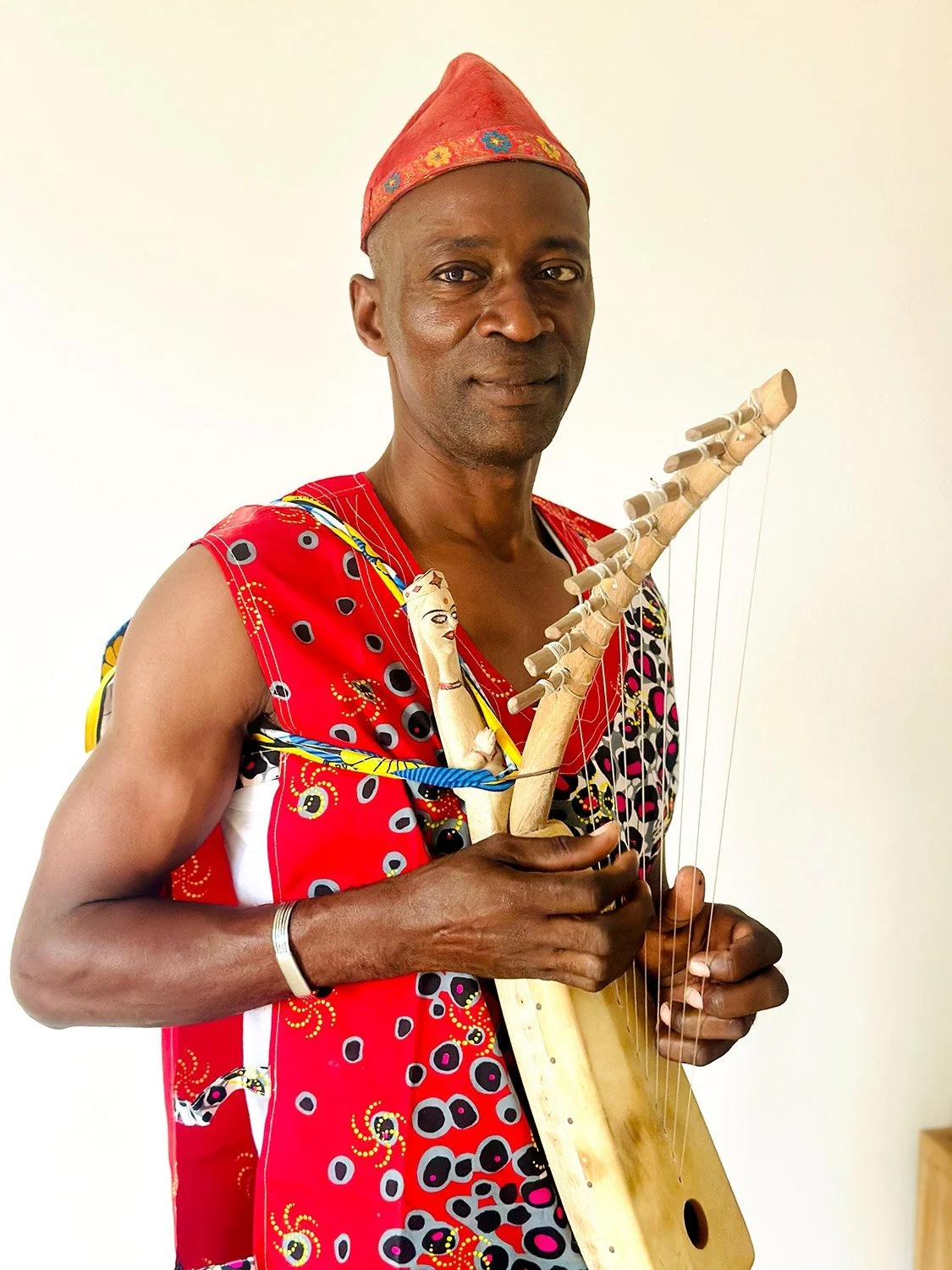
Akoué Eba Michel is a Beti Ngoma of the Bwiti Dissoumba Fang tradition. He received his first initiation at the age of three. At six, he became a Beti student, and at fifteen, he was consecrated as a Beti Master. He’s been serving as a traditional harp player for 33 years. He has undergone nine initiations under Master Atome Ribenga and has since consecrated four students of his own. His Spiritual name is Arc-en-Ciel (Rainbow). He is married and the father of nine children.
Beti Ngoma Michel discusses the sacred harp, its relationship with iboga and initiation, and his path to becoming a traditional harpist within the Bwiti Dissoumba tradition.
What is the role of the harp?
The harp represents love. It helps us to love ourselves. It is through this love that God created the universe. It is through this love that a man and a woman create a child.
It is this love that brings healing. It is this love that saves. It is this love that brings light, strength and peace. That is why the harp plays such an important role in the initiation, but also in daily life.
2. What is the relationship between the sacred harp and iboga?
Thought.
It is thought that comes as a result of the harp and iboga together.
Thought is what allows you to communicate with your Higher Self and the spiritual world.
If your thoughts are negative, the experience moves through negative thought. If your thoughts are positive, it moves through positive thought.
The harp supports positive frequency, so your thoughts and spiritual travel are positive — and you receive what you came for.
3. Why is the harp sacred?
The harp is sacred because it represents love, and love is sacred. It is through love that the entire universe multiplies and continues to grow.
Love is important with whatever you wish to develop—whether in the physical world or the spiritual world.
4. How does the harp guide or enable the initiate to see beyond? How does it communicate with the bandzi?
The harp enables the initiate to reach a higher level of faith. Whether in the physical world or the spiritual world, when the harp is played, the vibrational frequency changes.
The harp communicates with the bandzi by the harmonising faith, frequency and vibration. The harmony of faith allows them to hear the words that come from the Highest of virbrations. Frequency allows them to receive images, while vibration enables them to feel the spirit and experience the spiritual world.
The harp guides the bandzi through songs, prayers and the harmony of the music. These guide them along their spiritual path, allowing their journey to be illuminated and protected.
5. Does the harp have a role in spiritual protection?
Yes. The harp protects the place from the moment we invoke it through prayer, asking it to descend and join us in the work.
Spiritual protection is maintained by the divine planes. From birth until death and through resurrection, it is the spiritual realm that protects us. This protection comes from the Most High.
When we invoke those who come to protect us in spiritual work, they come from very far away. It is the harp that calls upon them.
The very first thing we do is protect the place. This is why, whenever the harp is brought into a place, we must first purify that place, to bring it into an aligned and positive frequency.
Wherever the harp is played, that place is completely protected spiritually.
6. How do you know that a ceremony has been performed well?
After completing a ritual or ceremony, personal and spiritual answers always emerge (in relation to the frequency that was harmonised during the initiation). Messages come through, and manifestations occur. This is how we know that the ceremony has been performed well.
7. What are the songs about?
The songs, sung in the Fang language, are about invocation. Everything we do within the tradition involves invocation. Prayer is a form of invocation, and songs of spiritual invocation are also forms of invocation.
What is invocation? Invocation means calling upon an entity to come and collaborate with you in spiritual work.
8. Is there a particular order in which the songs are played?
The songs are played in the order in which they originally arrived or were revealed. Each song calls upon a spirit that is meant to manifest. Every song carries a particular vibrational frequency, helping to harmonise the flow and direction of the ceremony.
9. What happens within you as the Beti when you play the harp during an initiation?
When I play the harp during an initiation, I remain connected to the being—the spirit—I encountered in the spiritual realm. Through my faith, songs and prayers, I invoke this spirit to come and dwell within my body so that I can play the harp.
The music then becomes spiritual music—the music of the universe. When people hear the way I play, they should recognise that it is not I who am playing, but the spirit playing through me.
10. How does someone become a spiritual harpist?
During initiation, a person can receive a calling to become a harpist.
Of course it takes some musical talent, but being born with a gift or talent for music is one thing, while learning to play traditional or spiritual music is another. However, the two can become equal through a person’s spiritual development.
In other words, someone who is not naturally gifted can still learn to play the harp. They can continue learning until they become an artist—a harpist. But to become a complete artist in the physical world, they must also be initiated so that they can encounter the spirit that plays the harp on the spiritual plane.
It is within the spiritual world that these things are revealed and where natural talent and learned ability can be connected at the same time.
11. What would you like people outside Gabon to understand about harp music?
I would like people outside Gabon to understand that harp music is spiritual music—the music of the universe. It helps elevate a person’s faith and is not simply ordinary music. Listening to the harp transforms a person’s inner spiritual frequency.
Interested in doing Bwiti Fang initiation? Join Michel, the Nima (consecrated spiritual father) and the team in South Africa, 8-13 November.
The waitlist is open.
For more information, please contact us.
Have questions you’d like to ask Michel about Bwiti Dissoumba Fang music, the harp or sacred wood? Get in touch!
