Q&A with a Bwiti Fang Nima (Spiritual Father)
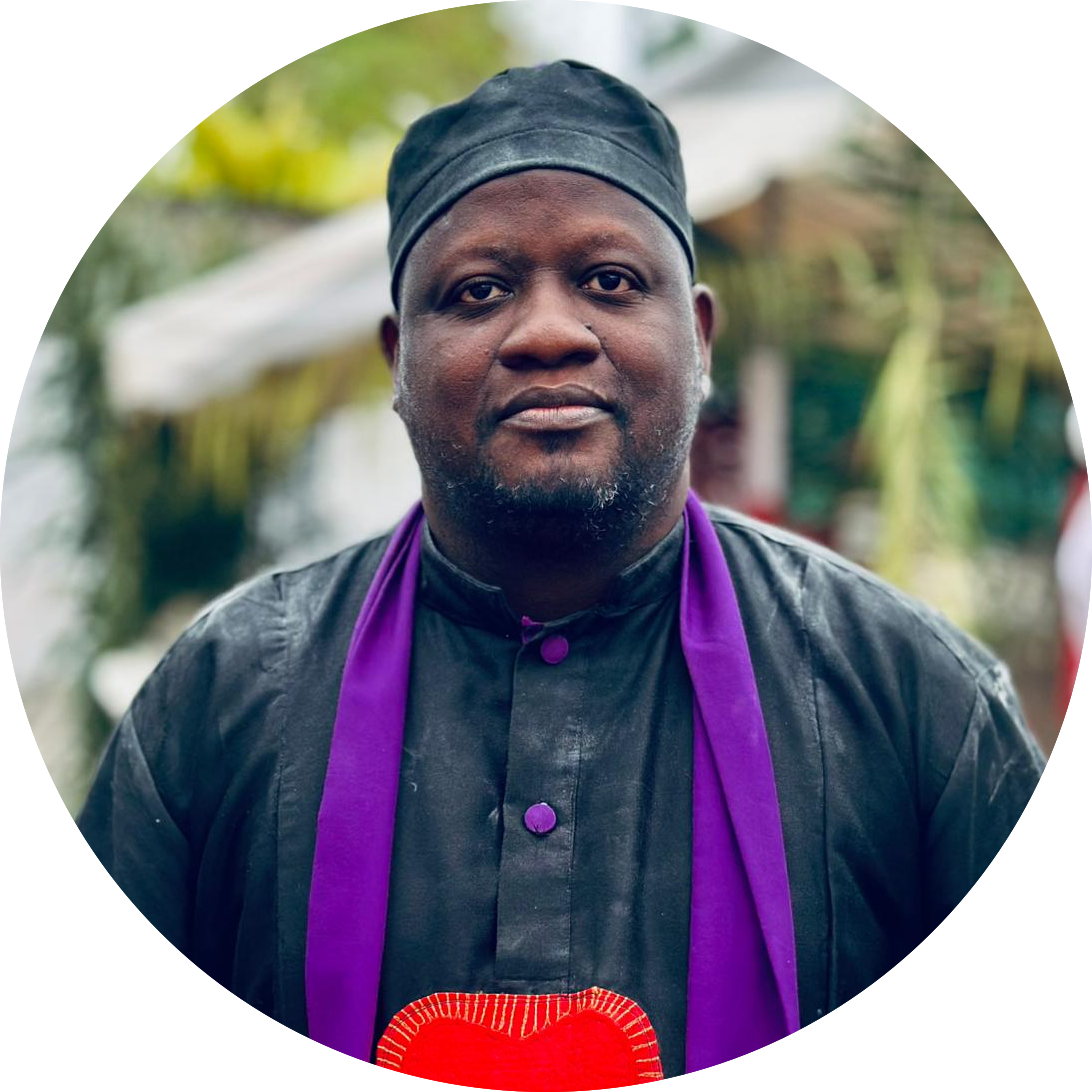
Ntoutoume Engono Marc Landry is a Nima (Spiritual Father) in the Bwiti Fang tradition. Born in Gabon, Landry began his spiritual training with renowned Nima Bwiti Master Atome Ribenga in June 2001. He was consecrated in 2018 in the Mboumba Eyano (Know Thyself) branch. His spiritual name is Feu (Fire) and he is the father of nine children.
Nima Landry answers questions about Bwiti, tradition, initiation, iboga (sacred wood), and his own process of becoming a Nima…
What is Bwiti initiation? What is its purpose?
Bwiti initiation is a set of practices that allows a person to connect with the mystical and spiritual world. What is its purpose? The purpose of Bwiti initiation is to awaken human consciousness, to shape the individual, and to allow them to connect with the Great Inspiration, so that they can transform their environment and be inspired in all their activities.
2. What is the difference between Bwiti, Bwiti initiation, and iboga?
‘Bwiti’ means the Unknowable — the unknowable God, the one who created the entire universe, the invisible cosmos (not the visible cosmos).That's why we say we don't ‘know’ the Bwiti, but we do know the Bwiti tradition, that is, the set of practices and knowledge applied to bring humanity into contact with the divine.
Bwiti initiation puts into practice this traditional knowledge to allow a person to progress towards the mystical and spiritual realms.
Iboga is a sacred tool and initiatory aid, but it is not mandatory to do this work.
3. What is the link between Bwiti and Christianity in Gabon?
A priori, there is no long-standing or traditional link between Bwiti and Christianity in Gabon.
Bwiti is a primordial tradition, which means it contains a fundamental wisdom from which many paths and teachings have emerged, e.g. Christianity. Like a tree with a single trunk and numerous branches all connected to the same source, the trunk represents the primordial. The various symbols encountered are all expressions of this primordial wisdom.
So while you may see some practitioners use Christian imagery in their rite, it’s not a ‘link’ between Bwiti and Christianity.
4. What is iboga and how is it used during spiritual journeys?
Iboga is a natural plant that serves as an aid in Bwitist mystical and spiritual initiations. To use it, you process the skin of the root into a powder. Then, you give this powder to the bandzis, who will experience the effects of iboga.
The iboga helps to open the bandzi’s energetic centres and perception, supporting them to journey deeply in the mystico-spiritual planes.
The main goal of a Bwiti initiation is not about eating iboga. It’s to meet your Higher Self. To know yourself. To experience the Spiritual world. And there are many ways to do that in the initiation. There are other sacred tools, like the song and harp.
5. Is iboga a hallucinogen?
Iboga is not a hallucinogen because what you see when you consume iboga is expressing truth. The experience and knowledge you receive in these journeys are not visions created by your mind. The knowledge and experience are real.
6. Your master, Atome Ribenga, speaks of people having a direct experience of the Divine through the Bwiti tradition. Could you explain what this means?
Indeed, mystical initiations allow human beings to have a direct experience with the divine, without going through the spiritual hierarchy. Humans can directly, without intermediaries, deal with God himself. That is precisely the purpose of the Mboumba Eyano initiation.
7. What is the sacred harp and why is it important in Bwitist initiation?
The sacred harp is a special aspect of Bwiti initiation, acting as one of the sacred tools that supports the journey of the bandzi (the one getting initiated). Beyond this, I cannot give further explanation because it is reserved for the Nima.
8. What can one expect during Bwiti Fang initiation, specifically Mboumba Eyano?
The process is to meet your Higher Self.
During Bwiti initiation, even if there are 1,000 people being initiated, each person will experience their initiation according to their destiny, their research, their level of development, and the quality of their thoughts. Therefore, there are no fixed things that one sees during initiations. However it can be that much is revealed, understood, cleared and expanded in a person’s life following initiation. Each person follows their own path.
The Mboumba Eyao initiation is specifically the initiation that puts a person in contact with their inner Self. It is the initiation of "Know thyself." It is about coming to know your inner being.
The Mboumba Eyao initiation is the foundation of higher spirituality because it leads you to discover yourself, to know who you truly are. It leads you to understand nature, the spiritual forces and the universe.
The difference between this initiation and the others is that the Mboumba Eyao initiation takes place within the person. No malevolent spirit, no external entity, can prevent you from coming into contact with your Mboumba.
Unlike other initiations, where a negative spirit, an external entity, or even the harmful thoughts of another person may interfere with your ability to connect with the spiritual beings involved in those initiations, this is impossible with Mboumba Eyano.
When you undergo the Mboumba Eyao initiation, contact with your Mboumba is inevitable. It must happen.
9. What does it mean to be initiated? What changes occur after initiation?
To be initiated means being born twice, as initiation is considered a kind of death, the only difference being that one is reborn, returning in the same body. The changes that follow initiation allow a person to have greater discernment, a deeper understanding of human beings, life, nature, and all living things, and it cultivates diverse forms of love within them.
10. Who should do Bwiti initiation and at what age?
Anyone who receives a calling. Your background doesn’t matter.
When? When the calling comes. You’ll feel the calling in your heart, inside you. You may also receive signs and symbols. Dreams, visions, sounds, feelings, sensations, perceptions… there are many ways to receive the calling.
You can continue to receive Bwiti initiations throughout your life, it doesn’t have to be a one-time experience.
11. Do you think Bwiti initiation and iboga are accessible to everyone? What preparation is necessary for Bwiti initiation?
Yes, Bwiti initiation and iboga are accessible to everyone, but they must be done under appropriate conditions by a Bwiti master. Preparation is necessary and is determined by the Bwiit master who, after consultation, will explain what preparation is required.
12. How are people sufficiently prepared to travel safely in the astral planes?
As soon as a person feels the desire to experience initiation into the spiritual realms, spiritual travel and mystical-spiritual initiations, that person is already prepared and ready to take the next step.
In the traditional process, we have a period of purification and this helps to put people in the right condition. Day after day, people are doing purifications.
It’s helpful to begin the purification well before you arrive. It’s better if you can stop drugs, alcohol, eating meat and medication ahead of the journey.
13. Can Iboga initiations go wrong? What are the risks? Have there ever been deaths during your ceremonies?
Iboga initiations when done by consecrated masters in the Bwiti lineage cannot go wrong. There is no risk. There have never been any deaths during our ceremonies because we have trained for this for many years (at a strict minimum, seven years of study).
We are prepared to act and react to any situation.
Things go wrong when inspired, but untrained people attempt this work. It’s like a person had a great surgery and now they want to offer surgery, despite never studying medicine. One thing is certain: that person will fail and peopl will be hurt.
However, a person who has attended medical school and studied medicine will know how to treat many different illnesses because they have trained for many years. It is exactly the same for us as Nimas with sacred wood and the initiation process.
14. When is Iboga an appropriate healing approach, and when is it not?
Iboga has mystical and spiritual characteristics affecting the full range of a person: the physical, spiritual, emotional, energetic, mental and astral bodies. Always and at every moment, iboga can be supportive.
However, people with heart conditions should not have iboga. But they can still be initiated — there are other tools, like sacred song and ritual bathing.
15. How can one best integrate the discoveries made during a Bwiti initiation into daily life?
The best way to integrate the discoveries made during a Bwiti initiation is to patiently wait for those discoveries to manifest themselves. Do not try to force things ahead of time, because everything has its proper time.
For example, before a child can sit on their own, they remain in their parents' arms. As time passes, a baby begins sitting up around six months, then crawling around seven or eight months, then walking around nine or ten months, and so on.
In the same way, after undergoing an initiation, one should allow events and realizations to unfold naturally and let things integrate on their own.
16. What was your first contact with Iboga?
My first contact with iboga was 14 June 14, 2001. It was my first Mboumba Eyano initiation under Master Atome Ribenga.
That is when I discovered God within myself. That is when I discovered my mission. That is when I understood that there is far more to discover than everything that exists on Earth.
I experienced peace, wisdom, and tranquility within myself. It was an experience I will never forget.
17. How did you become a Nima? What led you to do this work?
After my first initiation on June 14, 2001, I underwent many other initiations, around twenty of them, until 2013.
In August 2013, during another initiation, I received certain revelations that led me to enter the Bwiti Mystery School of Master Atome Ribenga.
Before that, I was already generally involved in his school, but in August 2013 I specifically entered the Mbumbeyano branch as a student.
It is an inner calling that every human being must feel—a calling that many feel today, many will feel in the future, and many have always felt.
18. What do you enjoy most about this work?
I love everything about this work. Everything.
I love going into the forest. I love giving explanations.
But above all, dear brothers and sisters, when I witness someone discovering the Divine within themselves, that experience is special. Extremely special.
When a person discovers the Divine spirit, the inner Self, the Intimate Being during an initiation, and tells me what they experienced, what they heard, the inner manifestations they witnessed, and what they felt—that is what brings me the greatest happiness.
Because that is our mission: to help our brothers and sisters discover their inner Self as well.
19. Why are Bwiti and Iboga becoming more popular outside Gabon?
We live in a special time where people are needing to reconnect with spirituality and their Higher Self. The time has come for this tradition to spring around the world. Humanity needs to reconnect with the Divine and return to the right path in the search for and understanding of God's manifestations.
People often feel they are missing something. Yes, they can work, make, accrue money, build scientific intelligence, but something is missing. The knowledge focuses solely on material things. But we are body and spirit. The Bwiti tradition can help the world find balance with these.
The shamanic tradition helps people to reconnect with Spirit and also works with the body. Often problems start in the spirit. In the West, they treat the symptom—the body, the material. We must use all tools available to achieve balance. The union of these tools will help create a better world.
The resurgence of the Bwiti tradition, with the aid of iboga as a sacred tool, has begun.
20. What is your opinion of Westerners who wish to experience a traditional Bwiti initiation? Is it appropriate for them to participate?
The Bwiti tradition does not belong solely to Africans, nor specifically to Gabonese people. No, it is a universal tradition.
It originally came from Egypt. People who traveled to Egypt in ancient times to study in the temples were studying this tradition.
The only difference is that its outward expression has varied according to races, customs, and ethnic groups around the world.
All people on Earth can (and should) be initiated into the Bwiti tradition because it is universal. It is not unique to Gabon, nor specific to Africa. It is a tradition of our planet, Earth.
Therefore, it belongs to everyone.
It has simply been preserved in Gabon for thousands of years due to historical and natural circumstances. Now, nature intends for it to spread once again throughout the world.
This universality is evident because there are similarities between the primordial Bwiti practices and traditions found in many other countries.
When people observe what is done in Bwiti and compare it with practices in places such as China, Tibet, France, or the United States, they often recognize similar principles expressed in different ways (the branches of the same trunk).
It is essentially the same tradition that diversified according to cultures, peoples, and the passage of time.
21: Is there anything else you’d like to add?
Yes.
My teacher, Master Atome Ribenga, used to tell us:
"Dear children, undergo a Mboumba Eyano initiation at least once every quarter, because Mboumba Eyano is the foundation of everything that exists."
And:
"Love one another, because we are all one and united."
Just as a father and mother may have several children who are all unique yet united through their parents, so are we united.
These are the two things I want to add in closing.
One must learn to know oneself. In our tradition, this is called Mbume Yano. Elsewhere it may be called the Inner Dragon, the Inner Self, the Intimate Being, the First Genius, or Kundalini.
It has many names depending on the cultures and peoples of the Earth.
This is what one must come to know and discover.
And one must love one's brothers and sisters.
Across the entire Earth, we are all brothers and sisters, regardless of our colors, customs, races, or languages.
We are all like the organs of a single body.
Like all the cells of one body, we are the cells of Mother Earth.
Dear brothers and sisters, I have finished.
Thank you.
Interested in doing Bwiti Fang initiation? Join Landry, the traditional harpist and the team in South Africa, 8-13 November.
The waitlist is open.
For more information, please contact us.
Have questions you’d like to ask Nima Landry about Bwiti Dissoumba Fang music, sacred wood or initiation? Get in touch!
